
VR Canopy Training for Skydiving Drop Zones and Instructors
The Problem:
Your Students Get 5 Minutes of Canopy Time Per Jump. It's Not Enough.
Every instructor knows the gap. Students exit, deploy, and have roughly five minutes to practice the most consequential skill in skydiving: navigating a canopy to a safe landing.
Five minutes. No do-overs. No pause button. Average canopy flight time for a student to learn the highest-risk phase of every skydive.
Canopypilot’s VR simulator gives drop zone owners and instructors a way to extend canopy training on the ground, where students can practice, fail safely, and build real decision-making skills before they jump for real.
Now instructors can verify a student is ready.
#1 cause
Canopy-related accidents are the leading cause of incidents in skydiving.
Source: https://www.uspa.org/the-2025-non-fatal-incident-summary-part-1-landing-incidents
Landing problems
US Parachute Assoc. data show that landing problems are the most common cause of incidents or accidents. Now, as an Instructor, you can help your students practice in VR before they jump for real.
Canopy navigation skill
Students can practice finding and reading wind indicators, evaluating drift, and adjusting the pattern in real time. Students experience the effect of wind on canopy flight before they feel it for real.
Who It Is For:
Instructors and Drop-zone operators who train skydive students
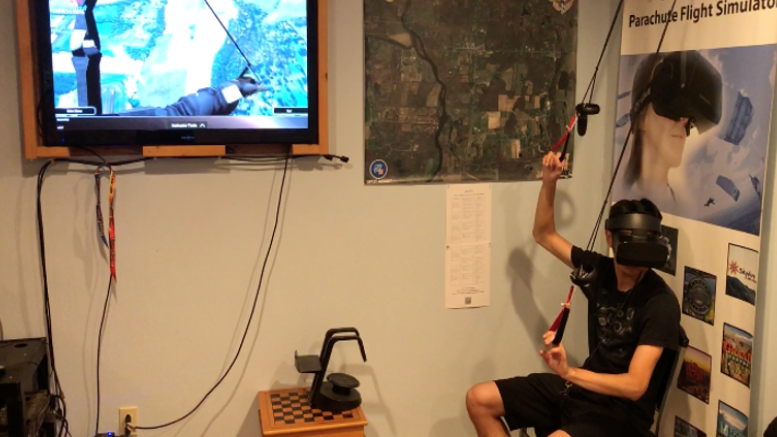
A Canopypilot setup in action: an ordinary chair, toggles, VR headset, and a big screen so the whole class can watch and learn.
An overview is available in the Instructor Corner of the November 2023 issue of Parachutist.
For more, watch the recording of “Virtual Reality as a Training Tool” (15 minutes) presented at the PIA (Parachute Industry Assoc) Symposium in Reno, NV, in February 2023.
And a link to the French Parachute Federation update on using Canopypilot software to assess VR as a training tool: 100% of students stated VR should be used to help learn how to fly your parachute.
DZ Owners
Canopy accidents don’t just harm students; they harm your business.
A single incident creates liability exposure, reputational damage, and investigative downtime. VR is a defensible investment in the safety systems your DZ runs.
And beyond safety, VR is a visible differentiator. Offering it signals to prospects and customers that your drop zone takes training seriously. It generates social content. It differentiates you from your competition.
Reduce incident & accident risk
Students do their first canopy flight decision-making with experience that ground school alone can’t build.
Stand out in your Market
Show your students that you embrace proven technology to help them be better prepared.
Generate Marketing Content
Use VR in 2D mode to generate the exact scene you want to convey to your potential customers.
Integrate into your existing program
Canopypilot slots into your current training flow to complement and consolidate your existing training program.
Instructors and Coaches
Right now, you can explain a landing pattern. You can show a video. But you can’t verify that a student has actually internalized canopy decision-making until they’re under canopy at altitude, with real consequences.
VR changes that. You can observe your student flying your actual DZ pattern, making real-time decisions, and correcting errors all on the ground. And you can record DZ-specific briefings in the software so students fly your pattern before they jump it.
Two Training Modes:
1 Coach Mode: Guide your student through scenarios as they see them, providing real-time advice as they make decisions in VR.
2 Test Mode: Stay silent and observe how your student handles themselves – verify they truly understand before they jump.
As an Instructor or Drop Zone manager, you now have the ability to provide students with a realistic, immersive learning experience before they jump.
Verify readiness before the jump
Supervise your student flying their canopy pattern in VR. Confirm they can make the right decisions before you clear them to jump in the real world.
Repeat scenarios at will
Crosswind landings, off-DZ emergencies, traffic conflicts: students and qualified skydivers gain experience in handling unusual situations.
Record your DZ briefing once
Bring consistency to your DZ briefing so you know all relevant points are covered every time.
Experiential Learning is proven to be effective
Record your landing pattern, landmarks, and outs. Every student flies over your actual DZ in VR before their first jump: they gain experience before they jump.
What Students Will Practice
What questions do students need to ask and how do they deduct the answers on a real jump?
Reinforce how a student can answer these questions during descent. Instructors can verify compliance:
1 of 9: Have they got a good canopy?
Students see from a pilot’s perspective what a good canopy looks like and how it behaves.
Result of using Canopypilot:
Students have a pilots perspective of what a good canopy looks like.
2 of 9: Do they look before turning?
Are students practicing this basic canopy safety skill?
Result of using Canopypilot:
Students learn muscle memory from the start: everyone is safer.
3 of 9: Can they find and track other canopies?
Another basic skill that can now be practiced.
Result of using Canopypilot:
Students can have the skill verified by an instructor before they jump.
4 of 9: Where is my landing area?
Can the student find the landing area? Local landmarks? What is the picture they expect to see on a real jump?
Result of using Canopypilot:
Students are more confident so they enjoy their jump more.
5 of 9: Can I get back to the landing area?
Students can now practice assessing their landing point.
Result of using Canopypilot:
Students get better at answering this key question on every skydive.
6 of 9: Assessing wind conditions during descent
Read wind indicators, evaluate drift, and adjust the pattern in real time. Students experience the effect of wind on canopy flight before they feel it for real.
Result of using Canopypilot:
Students can practice this key parachute navigation skill.
7 of 9: How do I get to my holding area?
Holding? Crabbing? Running? Other canopies? Full drive? Half brakes?
Result of using Canopypilot:
Students can practice decision making using information collected during the jump.
8 of 9: What is the traffic pattern?
Students can now practice flying the required traffic pattern.
Result of using Canopypilot:
Students gain experience before they jump for real so that everyone is safer.
9 of 9: Do I know my landing procedure?
Allow your students to see the moving picture to understand how fast it changes and when to flare. They can now practice landing with a full flare initiated at the correct height above ground.
Result of using Canopypilot:
Students who practice this key skill before they jump for real are much less likely to contribute to incident and accident statistics.
Other uses of Canopypilot on your Drop-Zone
Crosswind landing
Practice drift correction that would otherwise require several live jumps.
Result of using Canopypilot:
Students and licensed skydivers gain experience before having to land crosswind on a real skydive: they are a more confident pilot and less likely to contribute to incident or accident statistics.
Off DZ landing
Students practice identify, evaluating and committing to an off DZ landing area: the scenario that data proves most often goes wrong when it has never been rehearsed.
Result of using Canopypilot:
Students gain experience without suffering the consequences of a less than ideal decision.
Record training videos
Instructors can record short 2D videos showing relevant points of view of your DZ to enhance consistency in the information provided.
Result of using Canopypilot:
Viewers of those videos better comprehend and are more informed and aware.
FAQ
How much does it cost?
- VR-ready PC + VR headset: $3,500 total investment
- Space required: 6ft x 3ft
- Software: $1,000/year unlimited jumps
- Individual instructor can set up and operate
How does VR help students practice parachute flying before jumping?
Students experience realistic parachute flight scenarios where they must assess wind conditions, calculate landing approaches, avoid obstacles, avoid other canopies and time their landing flares. Instructors can coach them through scenarios or test their decision-making skills in a completely safe environment.
What parachute skills can students practice in VR?
Students can practice all the critical decisions that prevent landing incidents: wind assessment, landing point calculation, obstacle and other canopy avoidance, crosswind landings, off-DZ emergency procedures, and proper flare timing. They learn to collect and process information during descent just like they will in real jumps.
When should students use VR in their training progression?
We recommend VR training after students complete the first jump course but before their next real jump. This consolidates and complements existing ground school training with hands-on experience.
Is VR training approved for civilian skydiving instruction?
VR training supplements traditional instruction methods. In a 2025 study, Arnaud Devisy was commissioned by the French Parachute Federation to conduct a year long study on VR as a training tool. He found that VR training has evolved ‘from a gadget into a structured pedagogical tool,’ and concluded that if the investment prevents even one parachute accident per season, its cost is fully justified. Read the full study here: https://canopypilot.io/french-parachute-federation/
What if my dropzone has specific hazards like water or highways?
This is exactly where VR training provides the most value. Dropzones with deadly obstacles like rivers, lakes, motorways, railways, or buildings nearby benefit most because students can recognize relevant landmarks and practice hazard avoidance without real-world consequences.
How much instructor time does VR training require?
Each VR session takes about 15 minutes: brief as normal, jump in VR then debrief as normal or use the debrief tool we built into the application.
Testamonials

Darlene Kellner
As a skydiving center operator of 42 years (https://www.paskydive.com/), utilizing VR for canopy flight training has been game changing. The incredible realism of the VR allows the students to make the same mistakes they used to make on their beginning solo jumps but learn from those mistakes without getting injured!


Brian Germain
Author of The Parachute and its Pilot, the Ultimate Guide for the Ram Air Aviator: “Navigation is the part of the skydive that so many new canopy pilots struggle with. This amazing simulator helps so magnificently with this very aspect of parachute flight, with realistic physics and great visuals.”